ECTS credits: 3.5
Course parameters:
Language: English
Level of course: PhD course
Time of year: 5-9 October 2026
No. of contact hours/hours in total incl. preparation, assignment(s) or the like: 50/90
Capacity limits: 25 participants (first come, first served)
Course fee: No fee for PhD students enrolled at a Danish university (except for covering materials, travel, accommodation and meals). For PhD students enrolled at non-Danish university, a fee of 565 EURO will be charged (except for covering materials, travel, accommodation and meals).
Objectives of the course:
This course describes structured decision-making for addressing complex problems in conservation and natural resource management. Students will learn how to clearly frame decision problems, define objectives, and select analytical tools that are appropriate to the structure of the problem. Through a combination of lectures and team projects, the course will show how to assemble the essential components of all conservation decisions, including those involving single vs. multiple objectives, those that are static or dynamic, and those characterized by epistemic uncertainties (i.e., adaptive management).
Learning outcomes and competences:
At the end of the course, the student should be able to:
- develop transparent, defensible decision analyses,
- design strategies that explicitly link the broad decision context and the specific problem framing,
- design the methods needed to identify preferred conservation and management actions.
Compulsory programme:
Read selected literature in advance of the course, active participation, writing assignment (team project reports) for submission no later than 31 October 2026.
Course contents:
Day 1 — Decision Framing and Objectives
Hands-on Practicum
Day 2 — Analytical decision-support
Hands-on Practicum
Day 3 — Policy decision-support
Hands-on Practicum
Day 4 — Sequential Decisions and Adaptive Management
Hands-on Practicum
Day 5 — Real-world challenges in applying decision analysis in conservation
Hands-on Practicum
Problem finalization and presentation by project teams
Prerequisites:
The ability to think critically is essential for contributing to team projects. However, no advanced mathematical skills are required. No expertise in ecological modeling or monitoring is necessary (although knowledge of fundamentals is important). No programming expertise is required (although a basic familiarity with R would be helpful).
Name of lecturers:
Dr. Fred A. Johnson
Prof. Christian Damgaard
Dr. Kevin K. Clausen
Prof. Jesper Madsen (course responsible)
Type of course/teaching methods:
The course will consist of a combination of lectures, group work and discussions and hands-on practicum with selected case studies (team projects).
Literature:
Required textbook:
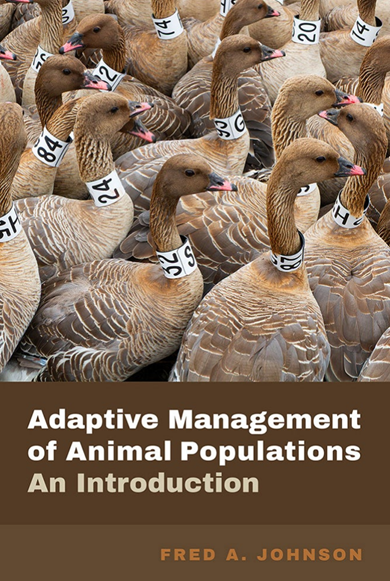
Johnson, F. A. 2026 (in press). Adaptive Management of Animal Populations: An Introduction. University Press of Florida, Gainesville, FL. (selected chapters; to be announced)
The book will be published in July 2026 and a student discount will be available. Details will be announced later.
Suggested readings:
Johnson, F. A., M. J. Eaton, J. H. Williams, G. H. Jensen, and J. Madsen. 2015. Training conservation practitioners to be better decision makers. Sustainability 7:8354–8373.
Hemming, V., A. E. Camaclang, M. S. Adams, M. Burgman, K. Carbeck, J. Carwardine, I. Chadès, et al. 2022. An introduction to decision science for conservation. Conservation Biology 36:e13868.
Williams, B. K., and E. D. Brown. 2014. Adaptive management: from more talk to real action. Environmental Management 53:465–479.
Course homepage:
None
Course assessment:
The performance of the participants be assessed (passed/not passed) based on active participation and contribution to project report.
Provider:
Department of Ecoscience
Special comments on this course:
Time:
5-9 October 2026
Place:
AU Campus, Universitetsparken, DK-8000 Aarhus C, Denmark
Course fee:
No fee for PhD students enrolled at a Danish university (except for covering materials, travel, accommodation and meals). For PhD students enrolled at non-Danish university, a fee of 565 EURO will be charged (except for covering materials, travel, accommodation and meals).
Registration:
Deadline for registration is 15 June 2026. Information regarding admission will be sent out no later than 25 June 2026.
For registration: Please use this link
If you have any questions, please contact Jesper Madsen, e-mail: jm@ecos.au.dk